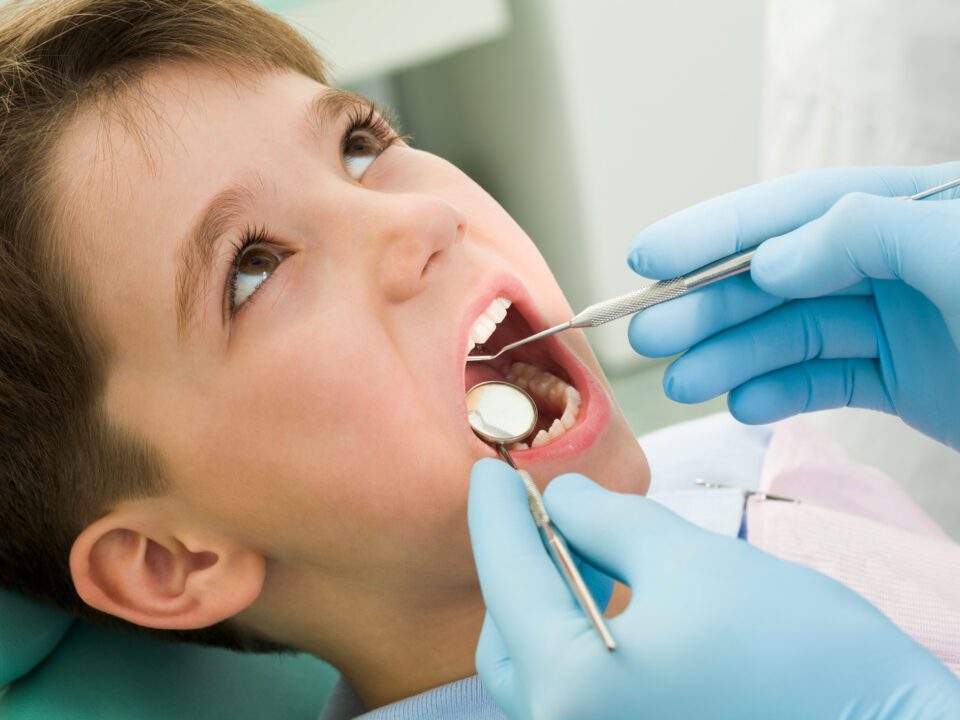

An early pediatric orthodontic evaluation at Village Family Dental is a dental screening conducted by age 7 to assess your child’s jaw and emerging teeth. This assessment identifies alignment issues before they become severe, reducing the need for invasive future treatments.
What occurs during an orthodontic evaluation
An early orthodontic evaluation at age 7 is painless and non-invasive. There are no drills, no needles, and no physical adjustments made during this first visit. Instead, our specialists focus entirely on observation and future planning. Here is exactly what happens during your child’s visit:
- Digital Imaging: Clinical evidence supports that imaging examinations are critical components of preoperative assessment for early orthodontic patients [1] (Lin et al., 2025). We take quick, comfortable, low-radiation X-rays. This allows us to see the adult teeth still hiding under the gumline and assess the jawbone’s structure.
- Bite and Alignment: We visually examine how your child’s upper and lower teeth come together. We look for crossbites, deep overbites, or open bites.
- Oral Habit: We look for physical signs of prolonged thumb-sucking, mouth breathing, or tongue-thrusting, which can actively change the shape of your child’s developing jaw.
- The Blueprint Conversation: We sit down with you to review the images. If everything looks great, we simply place your child in our observation program. If we spot an issue, we discuss a proactive plan.
When to bring your child in for an orthodontic assessment
While the American Association of Orthodontists recommends a baseline visit by age seven, certain physical cues mean you should schedule an appointment immediately. Noticing these subtle signs early can help prevent severe discomfort later. If you notice your child experiencing any of the following, contact our team:
- Loss of Baby Teeth: Losing baby teeth early can cause neighboring teeth to drift, blocking adult teeth from erupting.
- Difficulty Chewing: If your child frequently complains of jaw popping, their bite is likely misaligned.
- Prolonged Thumb Sucking: If your child is still sucking their thumb past age five, it can drastically narrow their upper jaw.
- Mouth Breathing: Chronic mouth breathing can alter facial growth and lead to narrow dental arches.
Do Early Orthodontic Procedures Hurt?
The initial evaluation and standard orthodontic treatments do not cause sharp pain and require zero sedation. Your child may feel mild pressure for a few days after an appliance is placed, but this is easily managed with over-the-counter children’s pain relievers. However, if your child’s Phase 1 treatment plan requires a minor procedure such as the gentle extraction of a baby tooth to create space for permanent teeth, we ensure they remain comfortable.
Clinical research supports that the popular appliances used for early orthodontic management include sectional fixed appliances, Herbst appliances, facemasks, rapid palatal expanders, and anterior bite planes [2] (Nguyen et al., 2025). In these cases, mild sedation options such as nitrous oxide can be highly beneficial. Nitrous oxide helps your child relax and wears off within minutes after the procedure, ensuring they feel absolutely no pain during the dental work.
Difference between phase 1 and phase 2 orthodontics
Understanding the difference between phase 1 and phase 2 is critical to making decisions about your child’s oral health.
- Phase 1: Occurs between ages 7 and 10, while the child still has baby and adult teeth. The goal is not to have straight teeth just yet. Instead, Phase 1 focuses on correcting the structure of the oral cavity. We guide jawbone growth to create space for crowded teeth and correct bite issues. The medical literature supports the use of interceptive orthodontic treatment with simple appliances during the deciduous or mixed dentition phase to correct certain malocclusions [3] (Schneider et al., 2022).
- Phase 2: This happens typically around age 12 or older, once all permanent teeth have erupted. This is when traditional braces or clear aligners are used to straighten teeth and enhance the smile’s aesthetics.
By completing Phase 1 treatment at Village Family Dental, you often drastically reduce the time your child needs to spend in Phase 2 braces during high school.
Table comparing orthodontic pathways:
| Treatment approach | Financial impact | Treatment duration | Discomfort |
| Early evaluation | Low | 6 – 12 months | Low |
| Traditional braces | Moderate | 18 – 36 months | Moderate |
| Delayed action | Highest | Years | High |
Cost, insurance, and value of your child’s smile
For families managing a household budget, the financial aspect of dental care is always a top priority. We believe transparent pricing is a crucial part of your healthcare experience. An early orthodontic evaluation is often highly affordable. In fact, many standard dental insurance policies fully cover this diagnostic visit. If Phase 1 treatment is recommended, we will provide a clear, itemized breakdown of the costs before any work begins.
For our patients across Fayetteville, Cumberland County, and the North Carolina Sandhills, Village Family Dental works to maximize your benefits. We accept most major insurance plans, including NC Medicaid, and offer flexible, interest-free financing options. Investing in early orthodontics is a financially sound decision. Fixing a minor alignment issue at age eight costs significantly less than having the unfortunate circumstance of requiring complex jaw surgery or prolonged teen braces at age fifteen.
FAQs
1. At what age should my child get their first orthodontic evaluation in NC?
The optimal age for a child’s first orthodontic screening is seven years old. At this stage, their first adult molars have typically erupted, allowing the orthodontist to evaluate the front-to-back and side-to-side relationships of their bite.
2. Do children feel pain during early orthodontic work, and is sedation used?
The initial evaluation is completely visual and painless, requiring no sedation whatsoever. If your child later requires a Phase 1 intervention, we offer child-friendly, safe sedation options (like nitrous oxide) to ensure they feel absolutely no pain or anxiety during the procedure.
3. What is the difference between Phase 1 orthodontics and regular braces?
Phase 1 orthodontics occurs while your child still has a mix of baby and adult teeth, focusing specifically on correcting jaw growth and creating space. Regular braces are typically applied when the child is a teenager, once all adult teeth have erupted.
References
[1] Lin, Z., Zhou, C., Hu, Z., Zhang, Z., Cheng, Y., Fang, B., He, H., Wang, H., Li, G., Guo, J., Guo, W., Li, X., Zheng, G., Li, Z., Zeng, D., Liu, Y., Liu, Y., Hu, M., Xia, L., Zhao, J., … Wang, T. (2025). Expert consensus on imaging diagnosis and analysis of early correction of childhood malocclusion. International journal of oral science, 17(1), 21. https://doi.org/10.1038/s41368-025-00351-1
[2] Nguyen M, Al-Moghrabi D, Tomlinson L, Azami N, Dolce C, Abu Arqub S. Early orthodontic treatment practices and perceptions: A cross-sectional survey of AAO members. J Orthod. 2025;52(3):285-294. doi:10.1177/14653125251358832
[3] Schneider-Moser UEM, Moser L. Very early orthodontic treatment: when, why and how?. Dental Press J Orthod. 2022;27(2):e22spe2. Published 2022 Jun 10. doi:10.1590/2177-6709.27.2.e22spe2