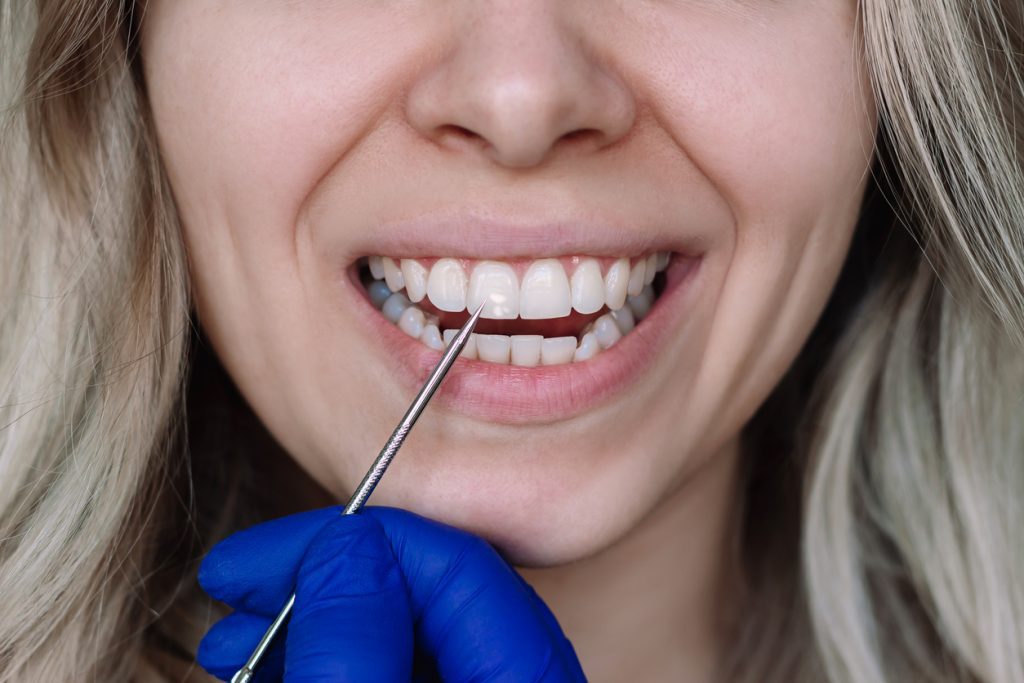
White spot lesions are early signs of enamel decalcification, where minerals have been lost from the tooth surface, appearing as chalky, opaque marks. In North Carolina, these are typically caused by plaque buildup or by excessive fluoride intake during development, and require professional remineralization or resin infiltration to prevent full cavities.
What Causes White Spots on Teeth?
Medical literature supports that white spot lesions represent the first stage of caries, and the prevalence has increased in recent years for patients undergoing orthodontic treatment [1] (Lopes et al., 2024). In the Hope Mills and Cumberland County area, white spot lesions usually stem from one of two sources: Decalcification or Fluorosis. Decalcification is the most common red flag. It occurs when dental plaque sits on the enamel for too long, creating an acid bath that leaches minerals out of the tooth. This is common among teenagers in the Sandhills region after their braces are removed, as brackets often create hard-to-clean areas. The second cause, Fluorosis, is unique to our North Carolina geography. Because many families in rural parts of the county switch between private well water and fluoridated city water, a child’s developing teeth may be exposed to too much fluoride. This results in white, lacy patterns that are present the moment the tooth erupts. At Village Family Dental, we use digital diagnostics to determine the type of clog your child has, as the treatment for a clogged pore in the tooth is very different from that for a mineral-starved one.
Reversing Damage Without Drills
In the past, the only way to fix a white spot was to wait for it to develop into a cavity, then drill out the decay. Today, our North Carolina clinics utilize Icon® Resin Infiltration. Clinical evidence suggests that resin infiltration proves to be an effective, minimally invasive approach for enhancing esthetics and clinical outcomes of white spot lesions [2] (Alkhuhayri et al., 2024). This is a needle-free treatment that stops the pre-cavity in its tracks. The process is simple and takes about 15 minutes per tooth. First, we use a gentle fruit-flavored gel to open the pores of the white spot. Next, we apply a specialized liquid resin that soaks into the tooth, filling the tiny holes where minerals were lost. Finally, we use a curing light to harden the resin. This not only strengthens the enamel but also changes the way light reflects off the tooth. Because there is no drilling, your child leaves our office without a numb lip.
Comparing Enamel Restoration Options
For parents balancing a household budget, it is important to understand the longevity and cost of different enamel treatments. Below is a comparison of how we handle white spots in our North Carolina offices.
| Feature | Medical-grade fluoride | Icon resin infiltration | Dental bonding |
| Best for | Early or minor spots | Moderate | Severe damage |
| Pain level | Zero | Zero | Minimal |
| Durability | High | Permanent | High |
| Maintenance | Re-applied at cleanings | Standard brushing | High |
| Cost | Lowest | Moderate | High |
Local water profiles and enamel health
Clinical literature supports that water fluoridation is a population health program that is in a unique position to equitably prevent dental caries [3] (Zokaie et al., 2022). In North Carolina, your zip code can actually predict your child’s risk for white spot lesions. If you live in the more developed parts of Hope Mills or Fayetteville, your municipal water likely contains the small amounts of fluoride needed to harden enamel. However, for our families in the outlying Sandhills, private wells may contain zero fluoride or, conversely, extremely high levels of natural minerals. During your consultation at Village Family Dental, we do not just look at the teeth; we look at the environment as a whole. We help parents determine whether their child needs a supplemental fluoride boost to close pores in their enamel or to adjust their toothpaste to prevent further spotting. This local expertise ensures your child is not just getting a one-time fix, but a lifetime of protection against North Carolina’s specific environmental dental challenges.
Cost and Insurance for Enamel Care
At Village Family Dental, we provide a transparent conversation regarding costs. Because white spot lesions are technically the first stage of tooth decay, many North Carolina PPO insurance plans and NC Medicaid (NC Health Choice) cover remineralization treatments as a preventive necessity. If your plan considers a specific treatment, such as Icon® or elective, we offer several ways to keep it affordable. We accept CareCredit, which allows you to split the cost of an enamel restoration into interest-free monthly payments.
FAQs
1. Can white spots on teeth go away with better brushing?
While improved brushing stops the spot from getting worse, it usually cannot “fill in” the lost minerals on its own
2. Are white spots on my child’s teeth a dental emergency?
They are not an emergency that requires a same-day visit, but they are an urgent warning sign.
3. Is the treatment for white spots safe for toddlers?
Yes! Our “Tell-Show-Do” method ensures that even 3-year-olds feel comfortable. Since treatments like Icon® or fluoride varnish do not require needles or drills, they are the perfect introduction to restorative care for young children.
References
[1] Lopes, P. C., Carvalho, T., Gomes, A. T. P. C., Veiga, N., Blanco, L., Correia, M. J., & Mello-Moura, A. C. V. (2024). White spot lesions: diagnosis and treatment – a systematic review. BMC oral health, 24(1), 58. https://doi.org/10.1186/s12903-023-03720-6
[2] Alkhudhayri, S. L., Alhassani, S. L., & AbdelAleem, N. A. (2024). Resin Infiltration for the Esthetic Improvement of Dental Fluorosis and White Spots: A Case Report. Cureus, 16(10), e72493. https://doi.org/10.7759/cureus.72493
[3] Zokaie, T., & Pollick, H. (2022). Community water fluoridation and the integrity of equitable public health infrastructure. Journal of public health dentistry, 82(3), 358–361. https://doi.org/10.1111/jphd.12480