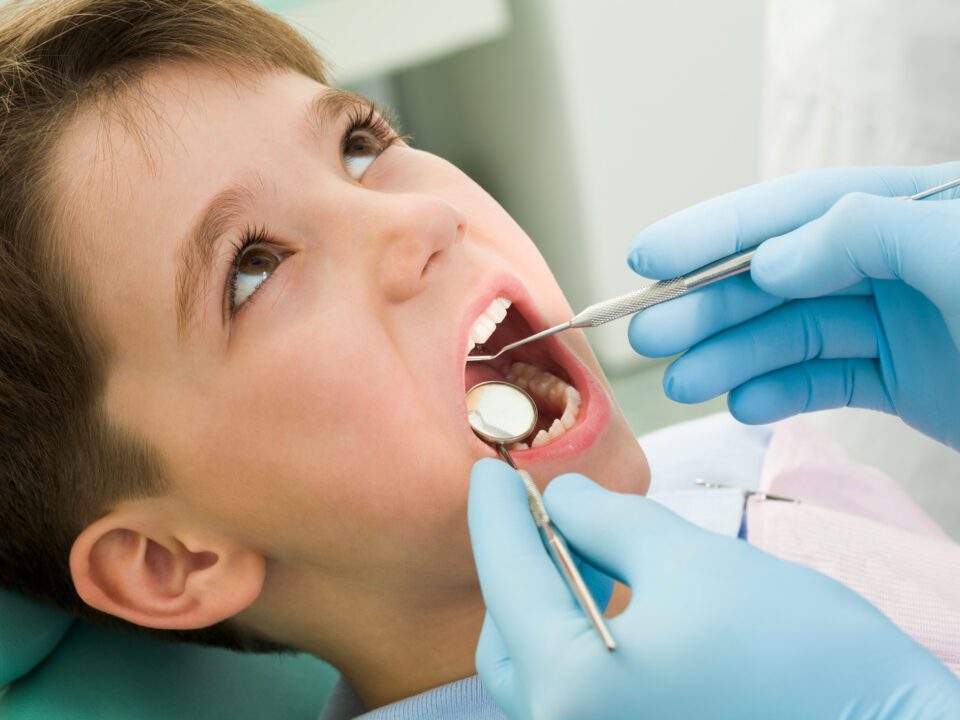

The American Dental Association states that dental sealants are systems that can be applied to the occlusal surfaces of teeth to seal anatomic pits and fissures (ADA, n.d.). At Village Family Dental, dental sealants are thin, protective coatings painted onto the chewing surfaces of the back molars. They work by sealing the deep grooves where plaque and bacteria hide, effectively preventing up to 80% of cavities and saving families from the high costs of future dental restorations.
The age to get dental sealants
A good time to apply dental sealants is immediately after your child’s permanent back teeth break through the gums. For most children, the first set of permanent molars arrives around age six. Clinical literature supports the practice of placing sealants on children’s permanent back molars as soon as they erupt (NIH, n.d.). The second set of permanent molars typically erupts around age twelve. By sealing these teeth as soon as they erupt, we prevent bacteria from entering and decay from starting. However, if your child’s premolars have deep grooves, our team may recommend sealing those as well. During your child’s routine six-month checkups, our clinical team closely monitors their dental growth and will let you know exactly when those molars are ready for protection.
Table comparing preventive care options:
| Feature | Dental sealants | Fluoride varnish |
| Mechanism | Physical barrier over grooves | Chemical remineralization |
| Target | Molars | All teeth |
| Application time | 3-5 minutes per tooth | 1-2 minutes for the whole mouth |
| Durability | Up to 5-10 years | 3-6 months |
| Maintenance level | Monitored during check-ups | Reapplied every cleaning |
| Cost | Low | Very low |
How Long Do Dental Sealants Last?
Dental sealants are durable and are designed to withstand the heavy forces of daily chewing. On average, a high-quality sealant can last from 5 to 10 years. Clinical research supports that the preventive fraction of resin sealants is up to 61% after 5 years (Ng et al., 2023). Because children are constantly growing and their bites are evolving, we monitor the integrity of the sealants during every routine cleaning at our St. Paul’s office. Over time, normal wear and tear can cause a sealant to naturally thin out or chip. If we notice that a sealant has worn down, the fix is fast and easy. We simply add a new layer of the sealant material over the affected area during their regular cleaning visit. This ongoing maintenance ensures your child’s teeth remain shielded throughout their most cavity-prone years.
Foods to avoid when sealants are applied
Dental sealants do not require a drastic lifestyle change. Because we use an advanced curing light to instantly harden the protective coating, your child can return to their normal diet as soon as they leave our office. However, to ensure the sealants last as long as possible, we do recommend a few minor dietary adjustments. You should encourage your child to avoid chewing hard ice or extremely hard candies, as this can chip the sealant. Additionally, highly sticky treats can occasionally grip the edge of a sealant and pull the material loose. By swapping sticky sweets for healthier, crunchier snacks like apples or carrots, you not only protect the sealant but also naturally scrub plaque away from your child’s teeth.
Can adults get sealants, too?
While we often talk about sealants in pediatric dentistry, tooth decay is not just a childhood problem. Many adults in Robeson County have deep, hard-to-clean grooves on their molars and frequently experience cavities. If you are a professional looking to avoid the cost and downtime of future dental drillings, you might be a great candidate for adult sealants. The rule is simple: as long as the molar does not already have a cavity or an existing filling, we can seal it. The application process is exactly the same as it is for children. For the busy adult or parent, adding a sealant to your own molars during your next dental cleaning is a smart, low-cost way to protect your natural smile for decades.
Signs Your Child is Ready for Dental Sealants
The most obvious sign is visual: take a look in the back of your child’s mouth. If you can see large, flat teeth with deep ridges fully emerging from the gums, it is likely time to protect them. Another hidden sign is if your child frequently complains about food getting stuck in their back teeth or struggles to brush those hard-to-reach areas effectively. If your child is entering a busy sports season or the upcoming school year, getting sealants applied now ensures their schedule will not be interrupted by a sudden, painful toothache. If you suspect those back molars are fully in, bring them into our St. Paul’s clinic for a quick evaluation, and we will handle the rest.
FAQs
1. Are dental sealants safe for my child, and do they contain BPA?
Dental sealants are incredibly safe and are endorsed by the American Dental Association (ADA). While some sealants create a trace amount of BPA when they mix with saliva, the amount is microscopic, far less than what your child is exposed to in everyday items like dust or food packaging. The massive benefit of preventing tooth decay far outweighs this negligible exposure.
2. Can my child eat immediately after getting sealants at your St. Paul’s office?
Yes! Because we use a specialized curing light to harden the sealant material instantly in the chair, your child can eat and drink normally as soon as they walk out of our office. We just recommend avoiding incredibly sticky candies (like taffy) long-term to ensure the sealant stays securely in place.
3. Is it too late for my teenager to get dental sealants?
Not at all. While we typically apply sealants when the first permanent molars erupt (around age 6) and the second molars erupt (around age 12), older teenagers without decay in their molars can still benefit greatly from the protection.
References
ADA. (n.d.). Dental Sealants on Teeth. Www.ada.org. https://www.ada.org/resources/ada-library/oral-health-topics/dental-sealants
NIH. (n.d.). Dental Sealants | National Institute of Dental and Craniofacial Research. Www.nidcr.nih.gov. https://www.nidcr.nih.gov/health-info/dental-sealants
Ng, T. C., Chu, C. H., & Yu, O. Y. (2023). A concise review of dental sealants in caries management. Frontiers in oral health, 4, 1180405. https://doi.org/10.3389/froh.2023.1180405