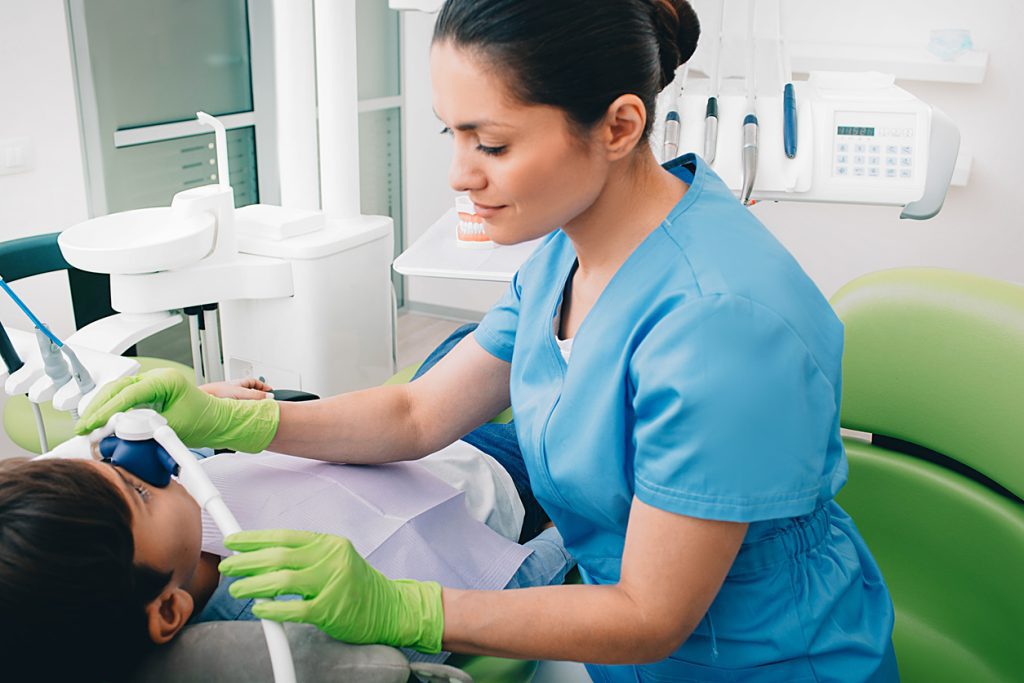
Twilight sedation for children, often called twilight sleep, is a moderate level of sedation in which your child remains conscious and can breathe independently but enters a state of deep relaxation. The procedure at Village Family Dental typically utilizes medications that induce temporary amnesia, ensuring the child has no stressful memories of the dental procedure.
Dental sedation and amnesia
The most significant advantage of Twilight Sedation is the amnestic effect. Medical literature supports that 0.3 mg/kg and 0.6 mg/kg provide effective sedation and amnesia for preschool children undergoing dental procedures [1] (Binh et al., 2025). While your child is technically conscious and able to respond to the dentist’s voice, the medications used create a temporary memory gap. To your child, this feels as though they sat in the chair, blinked, and were suddenly finished. This is not just about making the appointment easier today, but also a strategic move for your child’s future. By removing the memory of the sound of the dental handpiece or the pressure of a filling, we prevent the development of a lifelong dental phobia. Clinical research suggests that using this approach can effectively reset a child’s fear cycle, making them much more cooperative for future routine cleanings without sedation. Clinical evidence supports that deep sedation results in improved patient satisfaction compared to light/moderate sedation [2] (Hoshijima et al., 2021).
Difference between Twilight Sleep and General Anesthesia
In a hospital setting, a child is unconscious and often requires a breathing tube. In our Twilight Sleep protocol in North Carolina, your child remains in a dream-like state but maintains their natural, independent reflexes. They breathe entirely on their own and can even swallow normally. This middle-ground approach offers higher safety for standard dental work while still providing the deep relaxation needed to ensure your child does not struggle or feel distressed during the procedure.
Safety Standards for Pediatric Sedation
At Village Family Dental, we do not just meet state safety requirements; we exceed them. In North Carolina, the State Board of Dental Examiners has strict statutes regarding who can administer Twilight-level sedation. Our clinicians hold advanced, specialized permits that require hundreds of hours of additional training in pediatric airway management and emergency response. We utilize advanced hospital-grade monitoring technology to ensure your child’s vitals remain within a safe, optimal range. This data-driven approach gives you the peace of mind that your child is in the most capable hands in the Sandhills region.
Below is a table comparing twilight sedation to other sedation options
| Feature | Nitrous oxide | Twilight sedation | IV sedation |
| Recall | Child remembers the visit | Little to no memory | Zero memory |
| Responsiveness | Fully alert | Drowsy | Unconscious |
| Recovery time | 5 minutes | 2-4 hours | 6-12 hours |
| Best for | Mild anxiety | Moderate fear | Oral surgery |
| Maintenance | None | 24-hour observation | 48-hour observation |
The ability to perform multiple procedures under sedation
Clinical literature supports that to ensure safe and effective pediatric sedation, a well-functioning pediatric sedation team is essential [3] (Jang et al., 2024). One of the greatest benefits of Twilight Sedation is the ability to perform Quadrant Dentistry. Normally, if a child has four cavities in different parts of their mouth, a general dentist might require four separate appointments to avoid overwhelming the child. With Twilight Sedation, we can often complete all necessary dental work in a single, efficient visit. Because your child is relaxed and unaware of the passage of time, our pediatric specialists can work quickly and precisely. This means fewer days taken off work for you and, most importantly, only one recovery period for your child.
The “NPO” Protocol: Preparing Your Child for a Safe Experience
Safety during Twilight Sedation starts at home the night before. We follow a strict NPO (Nothing by Mouth) protocol to ensure the medication is safely absorbed and to prevent nausea. Because the sedative relaxes the stomach muscles, it is vital that your child’s stomach is empty.
- Midnight Cutoff: No solid foods, snacks, or dairy after midnight the night before the procedure.
- The 2-Hour Rule: You may offer clear liquids up to two hours before you arrive at our clinic, but nothing after that.
- Comfort item: We encourage you to bring a psychological anchor, a favorite stuffed animal, or a soft blanket from home. Having a familiar scent and texture helps your child transition into the Twilight state, making them feel secure and loved.
FAQs
1. Is Twilight Sleep the same as anesthesia at the hospital?
No. In a hospital (General Anesthesia), a breathing tube is often required. In Twilight Sedation at our Fayetteville office, your child breathes on their own and maintains their natural reflexes, making it a less invasive option for standard dental work.
2. Can my child eat after Twilight Sedation?
Your child will be numb for a few hours, so we recommend avoiding solids until the local anesthetic wears off. Start with clear liquids, then move to soft local favorites like grits or applesauce once they are steady on their feet.
3. Will my child say “funny things” when waking up?
It is common! As the sedative wears off, children may experience “paradoxical emotional lability.” They might giggle, mumble, or be slightly fussy as their brain “reboots.” This is a normal side effect and usually fades within an hour.
References
[1] Binh, N. Q., Ngoc, V. T. N., Khanh, P. Q., Huyen, N. P., Linh, T. K., Khanh, P. P., & Anh, L. K. (2025). Efficacy of Oral Midazolam for Sedation and Amnesia in Preschool Children with Dental Anxiety: A Double-Blind, Randomized Controlled Trial. Dentistry journal, 13(7), 308. https://doi.org/10.3390/dj13070308
[2] Hoshijima, H., Higuchi, H., Sato Boku, A., Shibuya, M., Morimoto, Y., Fujisawa, T., & Mizuta, K. (2021). Patient satisfaction with deep versus light/moderate sedation for non-surgical procedures: A systematic review and meta-analysis. Medicine, 100(36), e27176. https://doi.org/10.1097/MD.0000000000027176
[3] Jang, Y. E., & Kim, J. T. (2024). Effective and safe pediatric sedation. Anesthesia and pain medicine, 19(Suppl 1), S36–S48. https://doi.org/10.17085/apm.24046